Cryogenic Pump Technology
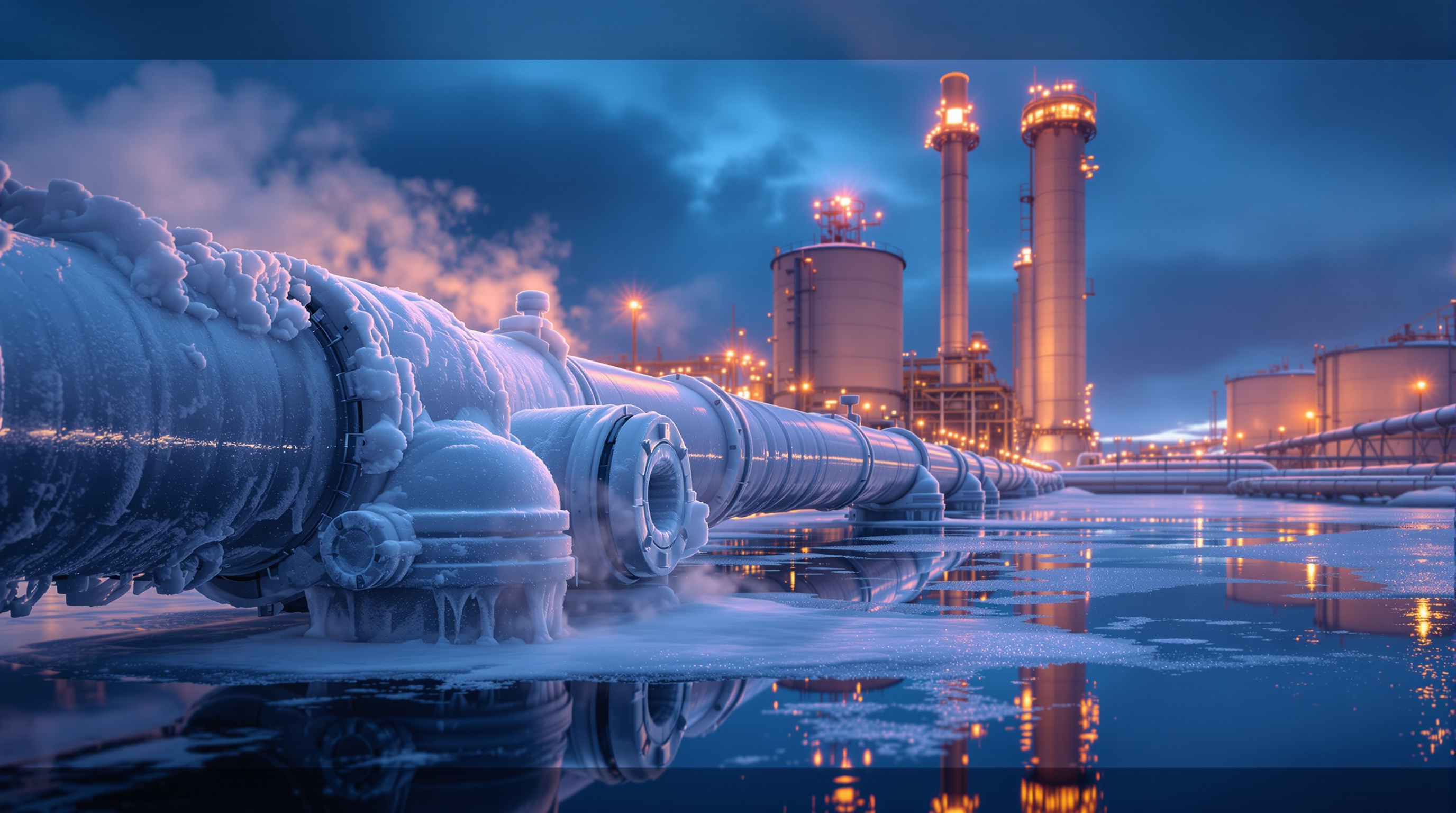
Pumping a liquefied gas is pumping on a knife's edge. LNG boils at −162 °C, liquid nitrogen at −196 °C, liquid hydrogen at −253 °C — every one of them is, by definition, a liquid stored at its boiling point. The margin between "liquid" and "vapor lock" is whatever subcooling the tank's pressure provides, often a matter of a degree or two. Add materials that must stay tough at temperatures where ordinary steel turns glass-brittle, and lubrication where every conventional oil is a solid, and you have one of pump engineering's most distinctive specialties — and one of its most quietly impressive success stories, because these machines now run for years between overhauls in the world's LNG terminals.
The Submerged Motor Solution
The modern cryogenic pump for LNG and similar service is a submerged motor pump: motor, bearings, and multistage hydraulics in a single vertical assembly, immersed entirely in the cryogenic liquid — inside the storage tank itself in a retractable well column, or in an external vessel called a suction pot. The lineage is unmistakable: this is the canned motor idea taken to its logical extreme. The pumped cryogen cools the windings and lubricates the bearings; there is no shaft seal because there is no shaft penetration; there is not even a rotating seal to the atmosphere anywhere in the installation. Submergence solves the suction problem (the pump sits below the liquid it pumps), the emission problem (the only boundary is static), and the ignition problem — in a flammable liquid with no oxygen present, the motor lives where a fire cannot.
Design refinements follow the fluid's logic. An inducer — an axial screw stage ahead of the first impeller — buys operation at the tiny NPSH margins a boiling liquid offers; thrust is balanced hydraulically so bearings carry the minimum load; motors are designed for the deep cold where, helpfully, electrical resistance falls and motor efficiency actually improves. Vacuum-jacketed piping and meticulous insulation keep heat — the enemy of every cryogenic system — out of the liquid on its way to the pump.
The Suction Side, Sharpened
Everything our NPSH note says about suction respect applies here with the dial turned to maximum. The available head over vapor pressure is set almost entirely by liquid level and tank pressure; friction or heat leak in a suction line converts directly into vapor. Cooldown procedure becomes operational doctrine: a warm pump dropped into cryogen flashes liquid violently until the metal mass reaches temperature, so controlled, instrumented cooldown precedes every start. Minimum-flow protection matters doubly, because a cryogenic pump recirculating on dead-head puts heat into a liquid with no thermal headroom at all. The fluid-property data underpinning these calculations comes largely from NIST, whose cryogenic property databases are the field's quiet foundation.
Materials in the Deep Cold
Carbon steel is disqualified early: it embrittles catastrophically well above LNG temperature. The cryogenic palette is austenitic stainless steel, aluminum alloys, and high-nickel steels — materials that keep their ductility to absolute zero's neighborhood — with every gasket, bolt, and instrument fitting chosen for the same property. Differential contraction is its own discipline: a machine cooled two hundred degrees shrinks measurably, and clearances, alignments, and piping loads must all be engineered for the cold geometry, not the warm one. Codes from ASME and the gas-industry safety standards (NFPA 59A for LNG facilities) govern the pressure boundaries and the installations around them.
Where the Cold Machines Work
Submerged motor pumps load and unload LNG carriers, send-out pumps push regasified-bound liquid from terminal tanks at high pressure, and in-tank pumps circulate against stratification. Air-separation plants pump liquid oxygen and nitrogen with machines of the same philosophy; hydrogen energy projects are extending it to the deepest cold yet. Smaller reciprocating cryogenic pumps fill cylinders and feed high-pressure vaporizers. It is a small family by unit count and an outsized one by consequence — global gas trade floats on it. For how this specialty fits the broader landscape, return to the technology overview; for the selection logic that would lead you here, see the sizing note.
LNG Export Scale in 2026
The Energy Information Administration's report on first-half 2026 LNG exports puts the trade in perspective: U.S. exports averaged 17.4 billion cubic feet per day, 23 percent above the same period in 2025. EIA attributed the increase to added export capacity and described it as the fastest growth since large-scale U.S. exports began in 2016.
A separate EIA report on the Corpus Christi terminal in Texas records completion of its seven-train Stage 3 expansion on August 28, 2026. Total terminal capacity reached 3.1 billion cubic feet per day nominal and 3.9 billion cubic feet per day at peak. These gas-volume figures describe export capacity; they are not liquid-flow duty points for an individual pump. Terminal totals provide context, while each pumping duty still needs its own flow and suction conditions.