Pump Selection and Sizing: Reading the Curve
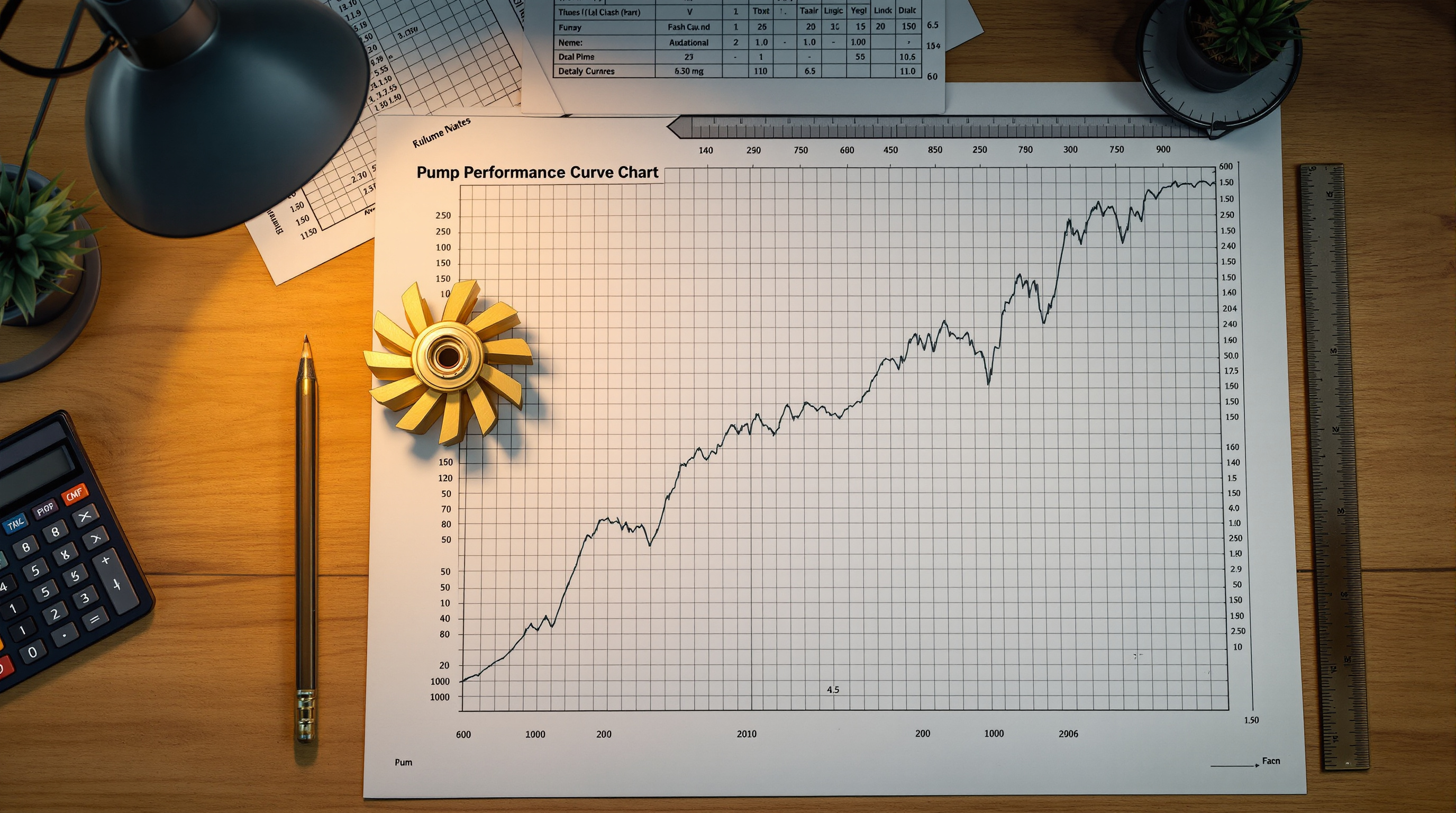
The most expensive pump mistakes are made before any metal is cut — on the datasheet, where an inflated flow figure, a guessed pressure drop, and a "just to be safe" margin quietly conspire to order the wrong machine. A pump selected two sizes too large does not merely cost more to buy; it runs away from its best efficiency point for its entire service life, burning power and shaking itself to pieces in slow motion. Selection is where reliability is born or lost.
Step One: Tell the Truth About the Duty
Everything starts with the duty point: the flow the process genuinely needs, and the head required to deliver it. Flow should come from the process engineer's mass balance, not from folklore. Head is arithmetic — static elevation change, plus vessel pressure difference, plus friction losses through pipe, fittings, and equipment at the design flow. The discipline is in resisting the urge to pad each term. Margins compound: 10% on flow, 15% on friction, and a "round up to the next impeller" at the end can produce a pump 40% oversized — and modern practice, documented at length in the Department of Energy's pumping system sourcebooks, treats systematic oversizing as one of industry's largest invisible energy bills. State margins once, explicitly, and stop.
Describe the Liquid Before Selecting the Meter
A metering-pump datasheet needs a fluid description, not just a chemical name. State viscosity across the temperatures the pump will encounter, because viscosity governs suction loss, valve response, and how readily the chamber fills. State vapor pressure at the same conditions, along with any dissolved or entrained gas; a liquid that releases gas on the suction stroke can occupy displacement that the calculation assumed belonged to liquid. Density belongs in the record as well, particularly when process demand is expressed as mass while the pump delivers volume.
Solids require more than a box marked present. Describe whether they settle, their likely size and hardness, and whether the mixture can remain uniform in the day tank and suction line. Those facts shape valve style, passage size, agitation, flushing, and the risk that a seat will be held open. Crystallizing or polymerizing liquids add another question: what happens in a stagnant valve chamber after shutdown?
Finally, compatibility applies to every wetted part — diaphragm, valve seats, balls, seals, tubing, and accessories — at actual concentration and temperature. The trade name alone is rarely enough to settle it. Give prospective suppliers the complete service description and ask them to document the proposed materials and operating limits. A well-chosen drive cannot compensate for a liquid end that will not fill, seal, or survive the fluid.
Step Two: Build the System Curve
Plot head required against flow for your system: a flat static component plus a friction component rising roughly with the square of flow. The shape matters enormously. A friction-dominated system (long pipelines, circulation loops) rewards variable speed control richly, because slowing the pump walks it down a curve the system follows naturally. A static-dominated system (lifting into an elevated tank, pressurized injection) does not — below the speed whose shutoff head equals the static head, flow simply stops. Knowing which world you are in decides your control philosophy before you look at any pump.
Step Three: Read the Pump Curve Like a Skeptic
A manufacturer's performance curve tells you, for each impeller diameter, how head falls as flow rises — along with efficiency contours, power, and NPSH required. Lay your system curve over it. The intersection is where the pump will run; gravity is not interested in where you intended it to run. Check, in order: Is the intersection near the best efficiency point? Hydraulic Institute guidance favors continuous operation in a preferred region around BEP (commonly cited as roughly 70–120% of BEP flow); far left of it, recirculation and shaft deflection eat seals and bearings, and far right, NPSHr climbs steeply. Does NPSH available beat NPSH required by a real margin at the actual operating flow — not just the duty point? (Our NPSH note covers why the margin matters.) Is the curve shape stable — continuously rising to shutoff — if the pump will ever run in parallel or under level control? Is the motor non-overloading across the realistic flow range, not just at duty?
Step Four: Choose the Family
Rotodynamic versus positive displacement is usually settled by three numbers: flow, head, and viscosity. Centrifugal pumps own the high-flow, moderate-head, low-viscosity world — which is most of the world (see the centrifugal fundamentals page). Reciprocating and rotary PD machines take over where flows are small and pressures high, where viscosity smothers centrifugal hydraulics, or where flow must be metered precisely regardless of pressure — the territory mapped on our metering page. The borderlands (moderate flow, high head; shear-sensitive or gas-laden liquids) are where engineering judgment, and a long talk with application engineers, earn their pay.
Then the fluid votes. Corrosives drive materials selection and favor sealless containment — canned motor or magnetic drive — when leakage is intolerable. Solids demand recessed or open impellers and generous clearances. Temperature extremes invoke their own technologies entirely; liquefied gases, for instance, belong to the cryogenic specialists. Standards supply the vocabulary for all of it: ASME B73 for chemical duty, API 610 for hydrocarbon services, API 675 for controlled-volume dosing — the resources page points to the publishers.
Step Five: Price the Lifetime, Not the Pump
Over a typical twenty-year life, the purchase price of an industrial pump is routinely a tenth or less of its total cost; energy and maintenance dominate. Life-cycle costing — comparing candidates on present-value energy, expected seal and bearing intervals, and downtime exposure — reliably changes decisions that first-cost comparison gets wrong. An efficient pump at BEP with a conservative seal environment is almost always the cheap pump, whatever the invoice said.
A Chilled-Water Example
A Hydraulic Institute life-cycle-cost case study published in June 2026 makes the comparison concrete. A hotel's chilled-water system needed some flow for 7,000 hours a year, with demand ranging from 51 to 204 cubic metres per hour. Peak flow was needed for only 3 percent of that time. Choosing from the peak alone would miss nearly the entire operating year. The demand profile supplies the missing information: how long the system actually needs each duty.
The study compared a single peak-sized pump with bypass recirculation, the same-sized pump controlled by a throttle valve, and three pumps each capable of about one-third of maximum demand, switched in and out and operated with variable frequency drives. Continuous full-capacity operation had the lowest energy efficiency. Throttling improved the result, but the switchable, variable-speed arrangement offered a further 30 percent reduction in energy consumption in this case.
The maintenance trade-off remained: more small pumps can cost more to maintain. The useful comparison therefore carries energy and maintenance together. Start with hours at each flow, then compare how each arrangement meets those duties. A peak-sized machine may cover the maximum requirement while remaining a poor fit for the hours that dominate the bill.
The Checklist
Honest duty point, explicit margins stated once; system curve drawn and classified (static- vs friction-dominated); intersection inside the preferred operating region; NPSH margin verified at maximum realistic flow; curve shape and parallel-operation behavior checked; motor non-overloading across the range; materials and sealing matched to the fluid; control philosophy (throttle, bypass, speed) chosen deliberately; life-cycle cost compared. Ten lines on a checklist — and twenty years of consequences.