A Short History of American Pumping
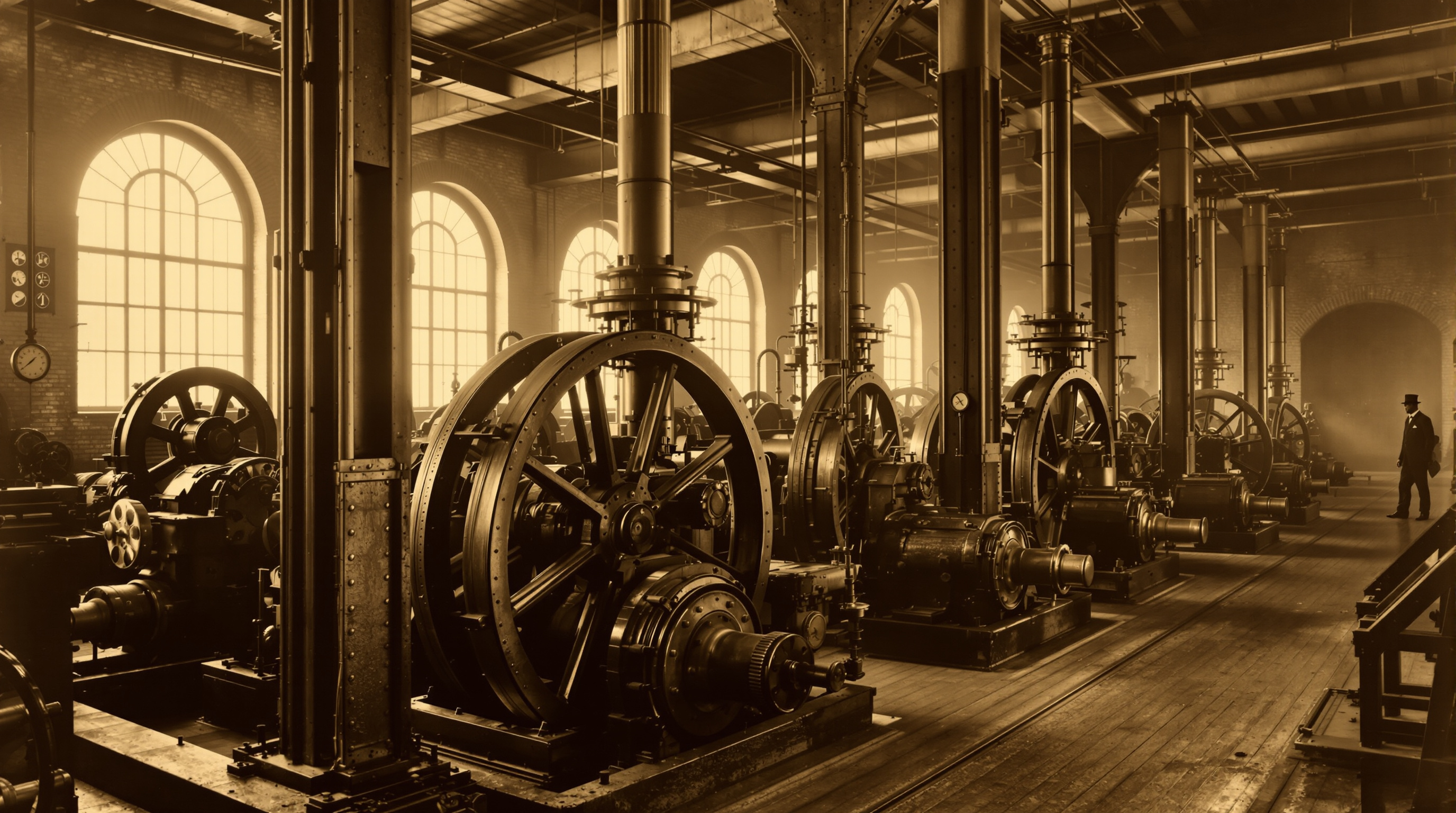
The history of pumping in America is really the history of what Americans needed moved. Cities needed water lifted; mines needed water removed; refineries needed crude pushed through crackers; the chemical age needed hostile liquids contained; the space and gas industries needed fluids handled at temperatures where rubber shatters like glass. Each demand produced machines, and the machines tell the story.
Steam and the Waterworks Era
Through the nineteenth century, the prestige pumping machines of America were the great steam waterworks engines — building-sized reciprocating pumps that lifted entire municipal water supplies. Cities competed on the grandeur of their pump houses, and the machines inside ran for decades. They worked on the positive displacement principle: a piston sweeping a cylinder, valves opening and closing, a fixed gulp of water per stroke. Reliable, efficient for their day, and enormous. The same era's mines, meanwhile, were kept dry by steam pumps whose direct-acting design — steam piston on one end of a rod, water piston on the other — became an American export to the world's mining districts.
The Centrifugal Revolution
The twentieth century belonged to the centrifugal pump. The principle — fling liquid outward with a spinning impeller and convert the velocity to pressure — had been understood for some time, but it needed a high-speed driver to shine. Electric motors provided exactly that. A centrifugal pump is mechanically trivial compared with a reciprocating engine: one rotating part, no valves, steady flow instead of pulses. Once motors became cheap and reliable, centrifugal machines displaced reciprocating pumps from all but the high-pressure, low-flow corners of industry. The economics of municipal water, power station circulation, and pipeline transport were rewritten around them. Organizations like the American Society of Mechanical Engineers codified their testing, and the Hydraulic Institute — founded in 1917 — began the standards work that still defines the field.
Pumping also became a way to store electricity. The Department of Energy's pumped-storage overview places the first known uses in Italy and Switzerland in the 1890s, with the first U.S. use in 1930. Two reservoirs at different elevations turn an uphill pumping duty into a later downhill generating duty: electricity lifts the water, and a turbine recovers energy as it returns.
The historical distinction is the purpose of the lift. Water is moved uphill so its stored energy can be released when needed. Pumping and generation belong to the same storage cycle, and the motor and generator roles belong in the same engineering picture. The pumped storage page follows that cycle, explains open-loop and closed-loop arrangements, and separates electrical capacity from the energy returned.
The Chemical Age and the Containment Problem
Mid-century petrochemistry posed a new question: what happens when the liquid must not, under any circumstances, reach the atmosphere? Packing glands wept by design; early mechanical seals improved matters but still failed unpredictably. Two answers emerged in the postwar decades, both elegant. The canned motor pump sealed the motor and the wet end into a single hermetic vessel, letting the pumped liquid itself cool the motor and lubricate the bearings behind a thin corrosion-resistant liner. The magnetic drive pump kept a conventional motor outside and dragged the impeller around through a sealed containment shell with permanent magnets. Japanese, American, and European manufacturers — several of them companies founded in the 1950s expressly to build sealless machines — turned both concepts into mature product lines, and the world's most hazardous liquids have been circulating inside them ever since.
The same era industrialized precision dosing. Water treatment, introduced at scale after the public health revolutions of the early twentieth century, needed chemicals fed in exact, adjustable, repeatable quantities; so did refinery additive systems and pharmaceutical processes. The controlled-volume metering pump — a reciprocating diaphragm or plunger machine with an adjustable stroke — became its own engineering discipline, eventually codified in API standard 675.
Cold Frontiers
The last act of the century took pumping to cryogenic temperatures. Liquefied natural gas, hydrogen, oxygen, and nitrogen all demand pumps that operate hundreds of degrees below zero, where conventional lubrication is impossible and any seal leak becomes an expanding gas hazard. The solution borrowed the canned-motor idea and submerged entire pump-and-motor assemblies inside the cryogenic liquid itself — machines explored further in our cryogenic pumping page. Today they load LNG carriers and fuel rocket test stands, the direct descendants of a century of containment engineering.
About This Reference
The Pump Room provides independent educational information about sealless, metering and other pump technologies. It has no connection to the active manufacturers discussed in this industry history. The full independence statement is on the About page.
What the History Teaches
Two lessons recur. First, pump progress has always been driven by the fluid, not the pump — every major design exists because some liquid was too hot, too toxic, too cold, or too precious for the machines before it. Second, simplicity wins over time: the dominant designs of each era are the ones with the fewest parts in contact with trouble. Keep both lessons in mind when reading the selection guide; they are surprisingly good instincts for choosing machines today.